See what’s exposing your servers.
Know what to fix first.
KINLEY AUDIT inventories your Linux and Windows servers, pinpoints the vulnerabilities that actually impact your environment, prioritizes them by risk, and builds an actionable remediation plan. Nothing is ever changed on your servers without your explicit approval.
An executive-ready report your leadership can actually use.
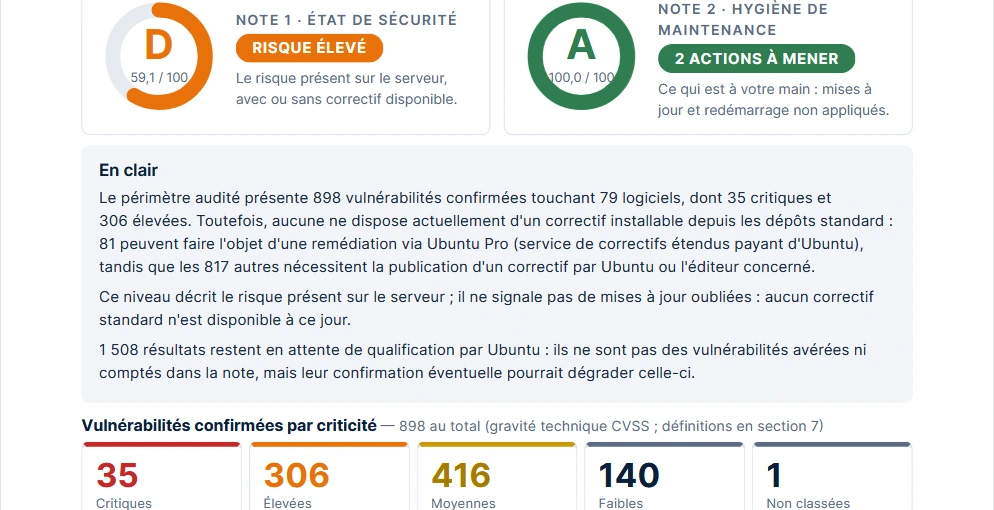
Page one is an executive summary: two clear scores, confirmed vulnerabilities, what can be patched today, and what is waiting on a vendor fix. The scoring methodology is explained right inside the report.
Latest security alerts
The critical Linux and Windows vulnerabilities of the moment, explained simply, with what to fix.
Hundreds of alerts. Almost no clarity.
Every publicly disclosed vulnerability gets a CVE identifier (Common Vulnerabilities and Exposures), such as CVE-2026-12345. A single server quickly racks up hundreds of them, and one package alone can account for thousands. Most are already patched, don't affect your installed version, or have no upstream fix yet, meaning a raw CVE dump won't tell you what to do next. KINLEY AUDIT handles the triage for you.
Signal, not noise
Every finding is cross-checked against your OS vendor’s official security advisories. Unconfirmed matches are flagged as “Needs review” so they never skew your score.
Actions, not endless lists
Thousands of CVEs usually boil down to a handful of updates. You get an actionable to-do list, grouped by package and by server.
Verified, not just marked done
A vulnerability is only marked resolved once a follow-up scan confirms the fix, not just because someone checked a box.
From inventory to verified remediation.
Deploy the agent
A lightweight agent enrolled via a single-use token (valid for 60 minutes). It only makes outbound connections to the platform; the platform never initiates inbound connections to your servers.
Collect the software inventory
The agent catalogs the OS, installed packages, kernel version, and running services. This inventory refreshes automatically before every scan, regardless of where the software is installed.
Analyze
Every package is cross-referenced against official vulnerability databases, vendor advisories, and the CISA Known Exploited Vulnerabilities (KEV) catalog.
Remediate and verify
Build your remediation plan, deploy updates once approved, and run a follow-up scan to verify the fix took effect.
Everything you need for vulnerability management. Nothing you don’t.
High-precision detection
Powered by official distro security trackers, the OSV database, the CISA KEV catalog, and Microsoft security bulletins. We separate theoretical fixes from patches you can actually install today.
Risk-based prioritization
Severity, active exploitation, patch availability, and reboot requirements: your remediation order is crystal clear.
Remediation planning
Bulk-select findings and let the platform organize them into actionable tasks, rollout batches, and confidence tiers. It drafts the plan; nothing runs until you say so.
Guided patching
Get a clear preview of every package to be installed, approve explicitly, let the agent execute, and review a full audit log. Zero hidden automation.
Progress tracking
Compare any two scans to spot newly discovered flaws, verify resolved issues, and track score improvements over time.
Smart alerts
Get notified in-app and by email, with built-in deduplication, whenever a critical CVE drops, an active exploit is detected, or an agent stops checking in.
Immutable audit trail
Logins, actions, reports, and patching runs are logged for 12 months in a tamper-evident database that blocks edits and deletions.
White-label PDF reports
Generate executive and technical reports under your own branding, complete with a plain-English breakdown of the scoring methodology.
Multi-tenant architecture
Manage multiple clients or business units from a single console with strict data isolation and four granular access roles.
Inside the platform.
Live screenshots captured from a test environment.
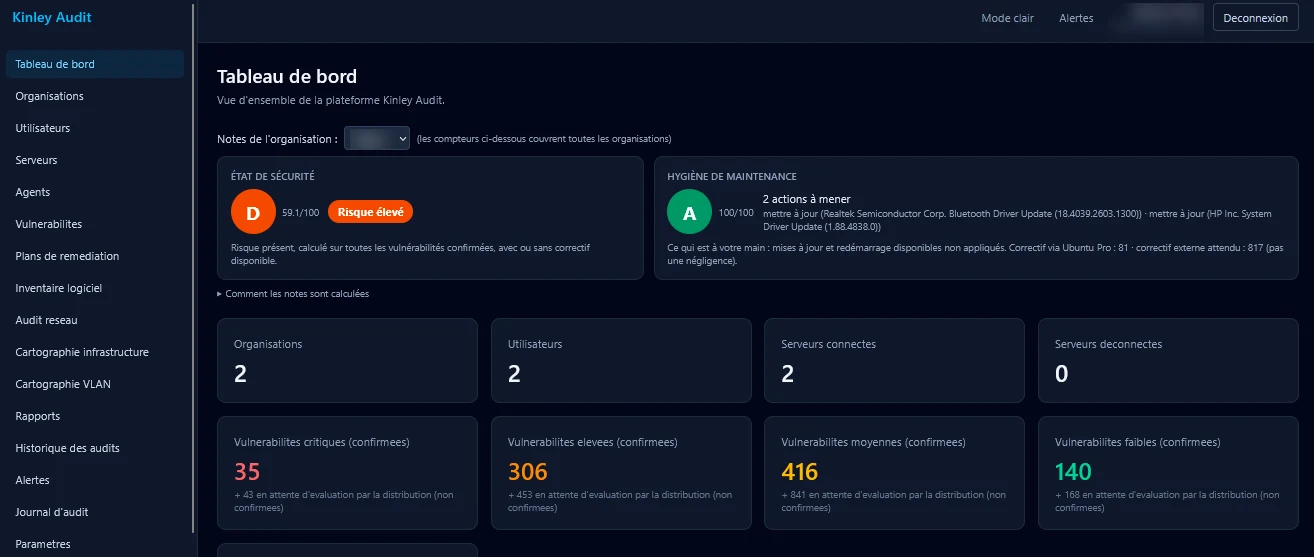
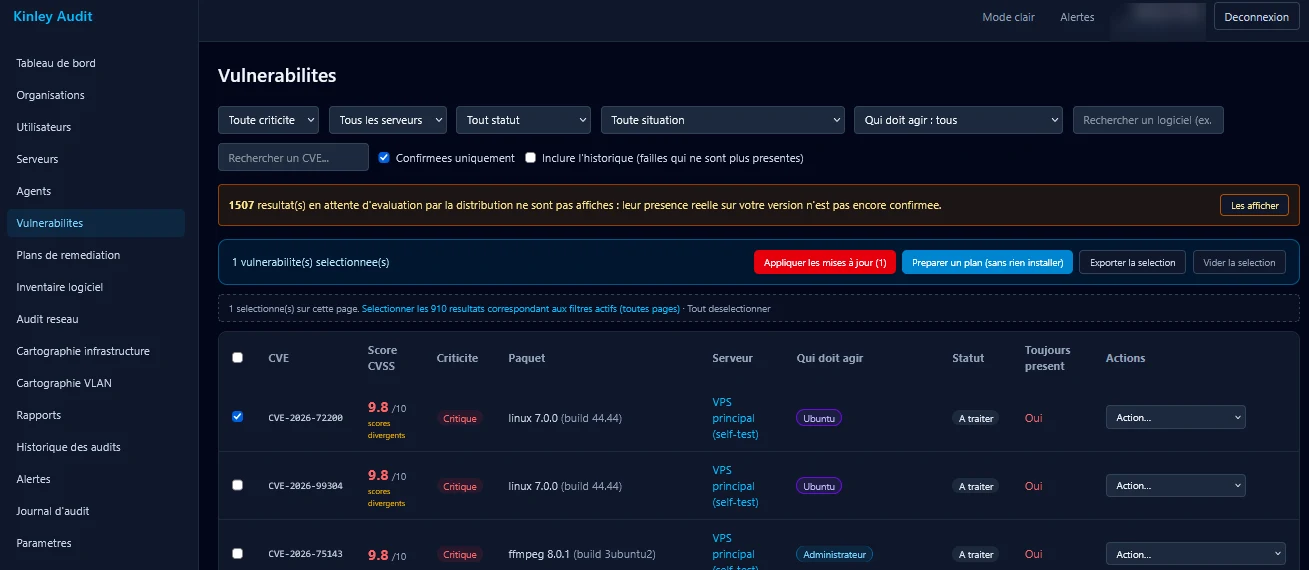
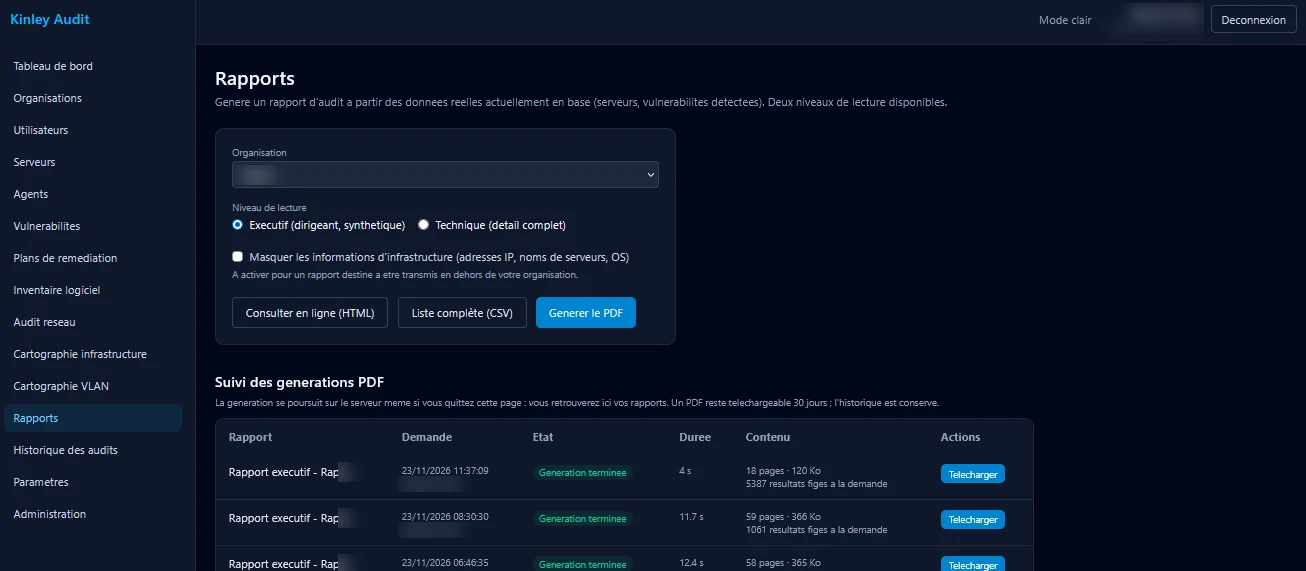
Two distinct scores for two distinct questions.
A single blended score hides what matters. KINLEY AUDIT separates your current exposure from your patching discipline, so you know who needs to take action.
How exposed are you right now? Scored per vulnerable package, so a single package carrying a thousand CVEs only counts once. Any actively exploited vulnerability automatically escalates the severity to Critical.
How well is your team keeping up with updates? Scored per pending action (updates, reboots). Vulnerabilities without an available vendor patch never count against your score.
Built so you never have to open an inbound port.
Minimal network footprint
- No inbound ports to open on audited servers
- One firewall rule: outbound HTTPS on port 443 to the platform
- No administrative credentials stored on the platform
- Agent secrets stored only as hashes
- One-command agent uninstall that leaves nothing behind
Control and traceability
- No remediation without explicit approval
- Bcrypt-hashed passwords and account lockout after repeated failures
- Secure cookie sessions and four access roles
- Tamper-proof 12-month audit trail and daily backups
- Multi-factor authentication (MFA) with an authenticator app and recovery codes available
Cloud-hosted by us, or self-hosted in your environment.
SaaS / Hosted available
We manage and host the platform for you. Just log in, deploy the agents, and start scanning, with zero infrastructure to maintain.
Dedicated / On-premises on request
Ideal for strict compliance environments where data cannot leave your perimeter. Custom-scoped and priced to fit your architecture.
One platform. Built for three types of teams.
Small and mid-sized businesses
Get clear visibility into your server exposure and next steps, without security jargon, plus an executive report ready for leadership or cyber insurance underwriters.
Internal IT and security teams
Granular risk prioritization, structured remediation plans, historical trend tracking, alerting, and an immutable audit trail built for compliance reviews.
MSPs and managed security providers
Strict multi-tenant isolation, white-label client reports, and scan-over-scan comparisons that clearly prove your ongoing value.
Vulnerability assessment for SMBs
Purpose-built for small and mid-sized businesses: uncover server weaknesses, get clear priorities, follow a step-by-step remediation plan, and share executive-ready PDF reports.
CVE scanner for Linux and Windows
Scan Linux and Windows servers for CVEs, flag actively exploited flaws (CISA KEV), and isolate vulnerabilities with a patch ready to deploy today.
Vulnerability management for MSPs and IT teams
Streamline vulnerability management across servers and client tenants: white-label PDF reports, smart alerts, scan comparisons, and a full audit trail. Custom pricing.
Frequently asked questions
Do we need to open ports on our servers?
No. The agent opens the connection itself, outbound over HTTPS (port 443), so no inbound traffic is required. When the platform needs something, such as a fresh inventory or an action you approved, the request is returned in the response to the agent’s next check-in.
Is two-factor authentication supported?
Yes. Every user can turn on MFA: a 6-digit code from an authenticator app (Google Authenticator, Microsoft Authenticator, Authy…) on top of the password, with single-use recovery codes. An administrator can unlock a locked-out account.
Will the tool change our servers on its own?
No. Nothing is installed, removed or restarted without your explicit approval, and you always see an exact preview of what will happen first.
Which operating systems are supported?
Ubuntu and Debian Linux, and Windows Server. Other distributions can be evaluated on request.
What if software is installed in a non-standard location?
It makes no difference. The agent reads the system’s package manager rather than scanning fixed directories.
Where does the vulnerability data come from?
From distribution security advisories, the open OSV database, the CISA Known Exploited Vulnerabilities (KEV) catalog and Microsoft security bulletins.
Where is our data stored?
With the hosted option, on infrastructure that we operate. With a dedicated deployment, inside your own environment.
How much does it cost?
Pricing is quote-based and depends on the number of servers, the deployment option and the level of support you need.
Let’s talk about your infrastructure.
Tell us a bit about your environment, and we’ll send over a tailored quote.
Thank you, your request has been received.
We will get back to you shortly with a proposal. If you need an answer right away, call 06 22 59 23 45.